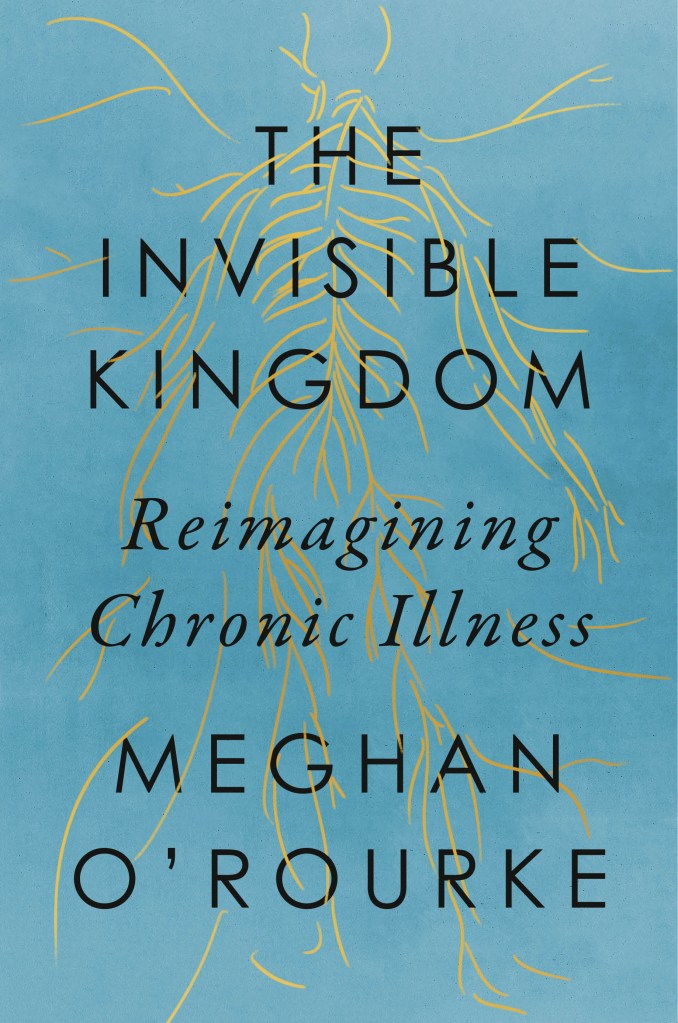
Title: The Invisible Kingdom: Reimagining Chronic Illness
Author: Meghan O’Rourke
Publication Date: March 1, 2022
Great for: A sense of community/solidarity
The Invisible Kingdom will not teach you how to heal your chronic illness, and it’s not supposed to. Sometimes people come to chronic illness books like this hoping for just that (myself, admittedly, too, okay?). So, I just want to say upfront that this is not a treatment book. What it is is one woman’s journey on the years-long, confusing, frustrating, self-blaming, try-anything-for-relief path to diagnosis with a chronic illness.
To ‘Rourke, we, all of us with chronic illnesses of one form or another (or multiple forms, for some), are “citizens of an invisible kingdom.” We suffer in silence, often. We hurt in ways no one can see. We struggle, but on the surface, we look “fine.” O’Rourke’s story is no different. She suffered from persistent, but inconsistent symptoms for years before anyone could offer even a possible explanation. Along the way, she turned to hyper-monitoring her nutrition, trying alternative treatments like a fecal transplant or IV therapy, and seeing specialist after specialist to try to get someone to listen to her, faced again and again with shut doors and suggestions to relax, eat better, sleep more.
As she recounts her story, she also dives into the history of chronic illness and the ways in which modern medicine, due to capitalism and the shifting emphasis of the medical industry over time, isn’t set up to help patients with mystery illnesses. Appointments are shorter and shorter, doctors relying on numbers more and more, which leaves patients who don’t fit diagnostic criteria exactly to fall through the cracks, even if something is really, really wrong. Doctors don’t, or can’t, spend the time necessary to get to the bottom of things. There’s also a section dismantling the idea that positivity is the cure for everything, which I particularly appreciated, arguing against that age-old quip that staying upbeat can cure cancer by citing follow-up studies that failed to recreate the oft-cited results and making a case to stop dismissing the often complicated and, yes, sometimes negative, feelings patients can have about their health.
I, for one, am not glad I have Crohn’s disease. I’m not stronger for the bruises from my infusion IVs on my arms. I have not learned any valuable lessons that make my disease worth it. It just is a part of my life and my personhood now.
The book is part memoir, and a rather poetic, beautifully-written one at that, and part argument for an upheaval in the medical industry. And while O’Rourke does turn to particularly extreme sources for relief from her symptoms, she’s not advocating that everyone go out and do what she did. It’s more to illustrate the lengths some have to go just to be taken seriously, to feel heard, and to try to feel better. She’s also quick to point out that she’s able to try these expensive treatments when many, due to financial strain or inaccessibility, cannot.
I particularly liked the emphasis in this book on the way self-blame often factors in for people who suffer from autoimmune conditions. We often think, well, this is my fault because I stayed up late last night, or I caused this because I ate spicy food yesterday. O’Rourke strictly regimented her diet, paid attention to everything she did and touched and ate, trying to find the culprit for how she was making herself sick. In the absence of a diagnosis to blame, hell, even with one, we think illness is something we cast upon ourselves. Something we have caused by some moral failing or another. Some punishment we have rightfully earned.
In one of my recent doctor’s appointments, mid-flare, I literally said out loud that I thought the flare was my fault because I had worked wonky hours the week before. My calprotectin was over 3000. Logically, I know nothing I did could have caused that, but I cast blame on myself anyway because my treatment had been working, and it came out of nowhere, and I had been drinking more coffee and eating a little worse to make it through a few overnight shifts, so that had to be the cause. In the absence of a wound, of something to point to and stitch up, it’s easy to turn the blame inward. Especially when it comes to autoimmune diseases, where the cause or the triggers are unknown entities, even differing from patient to patient.
I also liked the way she pointed out that the metaphors we use to talk about medicine can shape how we view it. It’s a small detail, but one I found really interesting to think about. For example, she writes, “if antibodies are soldiers fighting off an incursion of germs, then autoimmune processes become cases of mistaken friendly fire,” so, “we are misled by metaphor into seeing personal significance where there may be merely accident—or, indeed, systemic causes.”
This book is in conversation with many other chronic illness books, too, quoting from and commenting on the literature in the niche field. As someone who studied English in college, I enjoyed the perspectives O’Rourke adds from writers of the past who wrote about their feelings and experiences with illness, which, it turns out, are not so different from the ways I often feel with my illness. It’s a book that makes me want to pick up all of the books that are mentioned in it so I can stay in the conversation, and the sense of connection it formed in me. I have, I admit, always felt great relief that writers of the past have felt and thought the same things I do now, decades or centuries in the future.
O’Rourke wrote this book, “not only to try to explain the experience of being ill to myself, but also to help others confronted with the obstinate reality of a hard-to-identify chronic illness,” and I think she succeeded. While it is a long, sometimes repetitive read that offers no solutions, what it does offer is recognition. Recognition for how hard it is for people with chronic illnesses. How hard it can be for our loved ones. How disilluioning the current medical industry is. How the lessons we learn, the resilience, are things we might have rather not had to learn at all.
I recognized a lot of the feelings O’Rourke writes about, even if our journeys to diagnosis were very different, and I think you will too.

 My Crohn's Diaries
Leave a comment