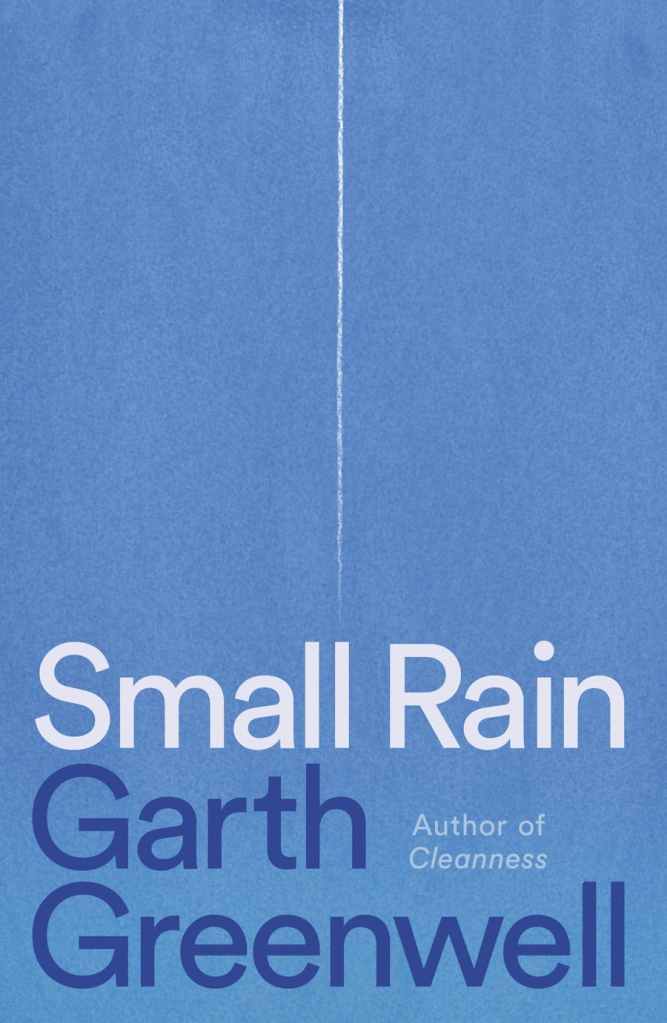
Title: Small Rain
Author: Garth Greenwell
Publication Date: September 3, 2024
Great for: a fictionalized capturing of the ways illness can change your future, and the precarity and uncertainty of life with a serious health condition
This is a little bit different than the books I’ve reviewed on this blog so far. But it’s my blog, and I review what I want! So, ha! While this isn’t a book about Crohn’s disease or IBD, it is about illness, pain, and reckoning with the way health conditions create an uncertain future in people living with them. Which…are all things I’ve felt as someone with a chronic illness. So, I say it belongs here just as much as any of the other books I’ve reviewed.
In Small Rain, the unnamed narrator is a poet and a teacher who is married to another poet and college professor named L. (His loved ones are all referred to by a single letter in this, and we never learn the narrator’s name.) After debilitating pain in his abdomen and groin for a few days, L convinces him to go to urgent care, who then send him on to the emergency room. There, he sits in a crowded hospital. It is 2020. COVID, though not at its peak any longer by the time he walks through the ER doors, is still rampant. In the ER, he’s soon diagnosed with infrarenal aortic dissection, a tear in a major artery. It’s something that, they tell him, should have killed him.
He’s put in a room in the ICU where a barrage of doctors come in, trying to figure out the puzzle of his diagnosis. What caused it, and what do they do now? They load him up with IVs, put him through test after test, and wake him up all night. His husband, L, can visit only for a few hours a day, leaving the narrator mostly, entirely alone. In the four walls of his room, he slips into his head as poets are wont to do, first in shock and overwhelmed by the turn his life had taken, unable to process that he could have died, that he could still die, that death was even an option for him at that point in his life. He is poked and prodded, made to pee into a collection tub, stripped down, and relegated to bed rest.
He meets doctors and nurses who sometimes do and sometimes don’t come back, having conversations with them or not. Bonding with them or not. One nurse he develops a particular friendship with. Another is ambivalent, new, seemingly not following the doctor’s orders, which sends him into a panicked night in which he presses the call button, and she does not come quickly or at all.
All of that to say, it’s a precarious situation for our unnamed narrator. He is suffering from an ailment for which they can’t quite decide how to treat. He’s confronted with the way the medical system operates around him as if he doesn’t matter at all. That, yes, while they will do everything they can to help him, he is still just a patient in an entire building of patients who get sick or hurt or die there every day. The white walls, the nothing channels on the television, the procedures he doesn’t understand that they perform on him anyway, so cool and casual in their minor cruelty, all in the effort of saving his life.
Greenwell captures quite beautifully the way in which something like that can change a person’s life. Yes, the pain, but also the lasting effects. The confrontation that things will be different, forever, now. The uncertainty whether the pain will come back, whether another tear would form, whether he’d ever know what caused it in the first place. It’s a very introspective novel about the complex feelings that come along with illness. In this case, it’s a particularly acute illness, but I think the same applies to anyone who is sick. The fear, the uncertainty, how big it feels when you realize that your life really will be different now. The recognition that often the treatments we endure come with collateral damage that we must accept.
It’s also a novel about, you guessed it, poetry. And, well, art really. The narrator studied music, too, for a while. And it certainly is a novel from the point of view of a poet. The language in this is rich, meandering, and cyclical. He ponders his whole life in that hospital room, a shut-in in-his-head book allows for that, but also he ponders a single poem for pages, a bird at the window, his renovated house, and the recent storm that sent trees tumbling into it.
It is a book that, because the narrator’s future is uncertain, can only dissect the past. And I recognize that feeling sometimes. That impulse to only ever look back because my future is full of doctor’s appointments and IV needles and calprotectin tests I have to drive to the lab and face people and hand it to them as if it’s not the most embarrassing thing to do (it’s not, but it is.)
And, my future does feel uncertain a lot. When will my next flare-up be? When will I have to take myself to the hospital again? Will I need surgery, an ostomy bag, or other drastic measures at some point?
All of that to say, I think this book captures a particular feeling that only illness brings. Yes, it’s a different sort of illness. Yes, it’s much, much more serious than anything I’ve faced. But the narrator’s (and author’s) ability to capture how it feels, sometimes, when navigating medical spaces. How isolating and dehumanizing it can be. How reliant we are on the medical staff we come into contact with. How hard it is to understand what, exactly, is going on, to ask the right questions, to know what to do.
But I think this book argues, a little bit, for the reflective nature of something like that. His ten or so days in the hospital don’t make him want to redo his whole life, but they do make him want to change in small, mundane ways. To appreciate his house more. To appreciate his husband. To appreciate the time he has on this Earth with the birds that poets write about and the trees that withstand storms.
I wouldn’t necessarily recommend this for those who don’t like books that take place mostly in the main character’s head. It’s a very reflective, at times slow, book and is very lyrical in nature (he is a poet after all). Nothing much happens, perse, though I think those of us with illnesses to some degree know that something very much happens in situations like this, even if it all does happen only in the four walls of an ICU and in the main character’s head. There’s not a lot of plot, is what I mean. There’s not much action to it. Which, I think, is the point! He’s ill! He’s waiting to find out what they’re going to do next! Of course, nothing is “happening.” Don’t we all know that in the medical world, almost everything is a waiting game?
I’m sure I have much more to say, but I won’t keep blabbering on about this. I liked this a lot! I think anyone who has spent time in the hospital, who has confronted the permanence of illness, or who has a loved one to whom any of this has happened, will appreciate this book and the language it gives to the experience.
If you read or have read this one, let me know what you think in the comments!

 My Crohn's Diaries
Leave a comment